10 Best Fantasy Languages for Writers and Worldbuilders
If you’re a writer or worldbuilder, you already know that the details make the difference between a forgettable story and an unforgettable world. One of the most powerful — yet often overlooked — tools in a writer’s arsenal is language. A well-crafted fantasy language doesn’t just add flavor; it signals to readers that your world has real depth, history, and culture behind it.
From J.R.R. Tolkien’s meticulously constructed Elvish tongues to David J. Peterson’s culturally rich Dothraki, the best fantasy languages feel like they belong to real peoples with real lives. In this guide, we’ll explore the 10 best fantasy languages ever created, what makes each one special, and what writers and worldbuilders can learn from them.
1. Quenya (Tolkien’s High Elvish) — The Gold Standard of Fantasy Languages
If there is one fantasy language that every writer should study, it’s Quenya. J.R.R. Tolkien — a professor of Anglo-Saxon at Oxford and a lifelong lover of linguistics — famously said he created Middle-earth just to give his languages a place to exist. That tells you everything you need to know about his priorities.
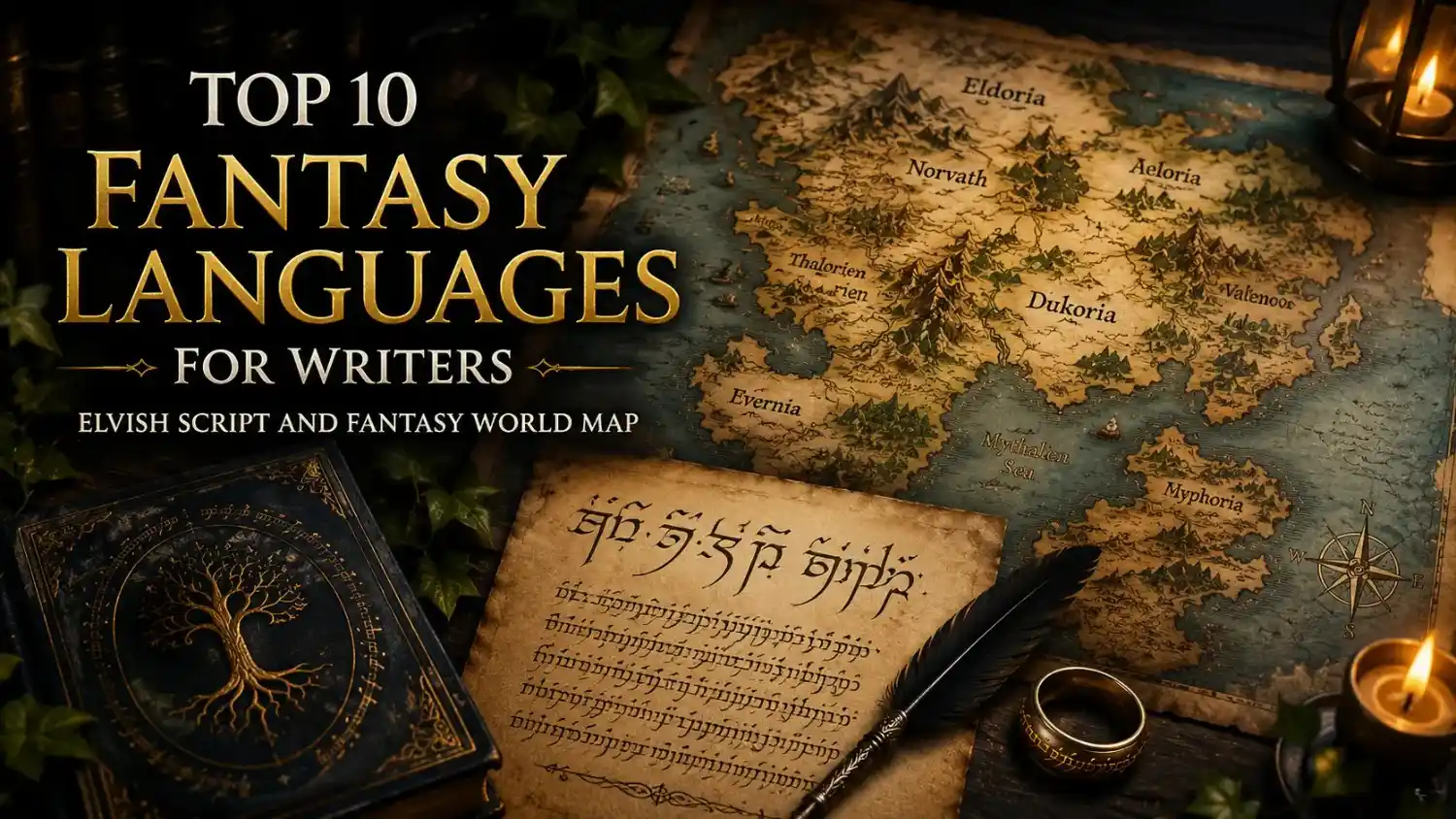
Quenya draws its musical quality from Finnish and Latin, featuring long flowing vowels and a complex but elegant grammatical system. Nouns decline into ten cases, verbs conjugate across multiple tenses, and the language even has its own script — the Tengwar alphabet.
What writers can learn: Root your language in real-world linguistic traditions. Tolkien’s languages feel real because they follow consistent phonological and grammatical rules. Pick one or two real languages as a foundation and let that influence your invented tongue.
2. Sindarin (Tolkien’s Grey Elvish) — The Language of Everyday Magic
While Quenya is Tolkien’s ancient, ceremonial language — the Latin of Middle-earth — Sindarin is the living, spoken Elvish of the Grey Elves. It draws heavily from Welsh, giving it a softer, more lyrical quality. Sindarin is the Elvish language most readers encounter in The Lord of the Rings. Place names like Rivendell (Imladris) and character names like Legolas are rooted in Sindarin.
What writers can learn: Consider creating multiple registers of your language — an ancient formal version and a modern everyday version. This mirrors how real languages evolve and adds tremendous depth to your world’s history.
3. Klingon — The Language That Escaped the Screen
Created by linguist Marc Okrand for Star Trek III: The Search for Spock, Klingon (tlhIngan Hol) is arguably the most culturally influential constructed language ever made. Harsh, guttural, and built around the warrior culture of its speakers, Klingon is so complete that fans have translated Shakespeare’s Hamlet and portions of the Bible into it. Duolingo even offers a Klingon course.
Klingon uses an unusual Object-Verb-Subject word order — a deliberate choice to make it feel alien and unlike most human languages. The Klingon Language Institute, founded in 1992, publishes a quarterly journal dedicated entirely to it.
What writers can learn: Let your world’s culture drive your language. Klingon’s aggressive phonology immediately communicates something about the Klingons as a people. Your language’s sounds should feel like an extension of your characters’ personalities and values.
4. Dothraki — Language as Cultural Mirror
When HBO’s Game of Thrones went into production, George R.R. Martin had only scattered Dothraki phrases in his books. Linguist David J. Peterson was hired to turn those fragments into a fully functional language — and he delivered one of the most culturally cohesive constructed languages ever made.
Dothraki draws phonetic inspiration from Spanish and Arabic, but what makes it extraordinary is its cultural specificity. The Dothraki are a horse-riding nomadic warrior culture, and the language reflects this completely: there are 14 words for “horse” but no word for “thank you.” The word for “sea” is derived from the word for “poison.” Every lexical choice tells you something about how the Dothraki see the world.
What writers can learn: Build your vocabulary around your culture’s priorities. What does your fictional people care about most? Let those answers shape which concepts get precise words — and which get none at all.
5. High Valyrian — The Language of Power and Magic
Also created by David J. Peterson for Game of Thrones, High Valyrian is the ancient prestige language of the Valyrian Freehold — a fallen empire whose legacy echoes throughout the world. Think of it as the Latin of Peterson’s invented setting: a language of scholarship, magic, and aristocracy.
Peterson built Valyrian from only 56 phrases that Martin had written in his books, expanding it into a full language with complex noun classes, a rich verb system, and multiple regional dialects. Its musical elegance deliberately contrasts with rougher Dothraki, signaling the difference between two very different civilizations.
What writers can learn: If your world has a history of empire or conquest, consider a prestige language associated with power and education. The tension between a dead prestige language and living vernacular tongues can drive fascinating social and political conflict.
6. Na’vi — Language in Harmony with Nature
Linguist Paul Frommer created Na’vi for James Cameron’s Avatar, and it stands out as one of the most harmonious-sounding fantasy languages ever constructed. Designed to reflect the Na’vi people’s deep connection to their moon Pandora, the language features an elegant triconsonantal root system and a phonology that is beautiful to the ear while remaining linguistically consistent.
Na’vi has grown into a thriving fan community — the Learn Na’vi community has thousands of active members who continue developing the language alongside Frommer.
What writers can learn: Your language’s sound palette should match the emotional world of your people. Na’vi’s flowing sounds feel right for a people who commune with their ecosystem. A desert civilization might sound drier and more clipped. A seafaring culture might have rounder, more rhythmic speech patterns.
7. Black Speech of Mordor — The Power of a Dark Tongue
Tolkien created the Black Speech as the official language of Mordor and Sauron’s servants. It was designed to feel oppressive and corrupt — a direct contrast to the beauty of Elvish. The most famous example is the inscription on the One Ring: “Ash nazg durbatulûk, ash nazg gimbatul…” — words so disturbing that Gandalf refuses to speak them aloud in the Shire.
Tolkien deliberately kept Black Speech sparse and harsh, with no poetic literature or cultural richness. It is a language of domination, not community.
What writers can learn: You don’t need a fully developed language for every culture in your world. Sometimes a few well-chosen words — if they sound right — can be more powerful than thousands. The Black Speech works precisely because it feels wrong.
8. Parseltongue — Language as Identity and Metaphor
J.K. Rowling’s Parseltongue, the language of serpents in the Harry Potter series, is one of fantasy fiction’s most elegant uses of invented language. It isn’t a fully constructed linguistic system, but it functions brilliantly as a narrative device. The ability to speak Parseltongue is treated as both a gift and a mark of darkness — historically associated with dark wizards and Salazar Slytherin.
To non-speakers it sounds like hissing, but Harry understands it as normal speech. This slippage between languages is used to stunning dramatic effect throughout the series.
What writers can learn: Not every language needs grammar charts and vocabulary lists. Sometimes a language works best as a symbol — a narrative marker of identity, heritage, or moral alignment. Ask yourself what speaking a particular language says about your character.
9. Dovahzul (Dragon Language) — Language as World Logic
Created by Bethesda Game Studios for The Elder Scrolls V: Skyrim, Dovahzul is the language spoken by the dragons of Tamriel. What makes it fascinating is the way it is woven into the game’s magic system: the Thu’um, or “Voice,” is a form of power in which speaking words in Dovahzul literally shapes reality. Words like Fus Ro Dah (“Force Balance Push”) became instantly iconic in gaming culture.
Dovahzul has its own runic script, consistent phonological rules, and a vocabulary developed in collaboration with the game’s fan community.
What writers can learn: Consider making your language mechanically significant within your world’s magic or power system. When speaking certain words does something, it raises the stakes of every conversation and gives linguistic knowledge real value in your story world.
10. The Old Tongue (Wheel of Time) — Dead Languages and Living History
Robert Jordan’s Wheel of Time series features the Old Tongue, a language spoken by the peoples of a previous age that is largely dead by the time of the main narrative. Only scholars and certain warriors use it — but its influence echoes throughout the world in place names, oaths, and terms of power.
Jordan used the Old Tongue to signal antiquity, status, and connection to a lost heroic era. When a character speaks it, something significant is happening. It functions much like Latin in medieval Europe — a marker of education, spiritual authority, and ancient power.
What writers can learn: A dead or dying language can be one of the most powerful worldbuilding tools you have. It shows your world has history — that people lived and built things before your story began. A language in decline can also create conflict between tradition and modernity that fuels compelling plot lines.
Tips for Creating Your Own Fantasy Language
Studying these 10 fantasy languages reveals universal principles you can apply to your own worldbuilding:
- Start with culture, not vocabulary. Know your people before you name their words. What do they value? What do they fear? Let those priorities shape what gets precise language and what doesn’t.
- Root it in real linguistics. Borrow phonological patterns from real languages you find beautiful or fitting. This makes your invented language feel organic rather than arbitrary.
- Consistency is everything. You don’t need thousands of words. You need the same rules to apply every time you use them.
- Let the language drive story. The best fantasy languages don’t just exist in the background — they create conflict, signal identity, and carry meaning that plain narration cannot.
- You don’t have to go full Tolkien. A handful of evocative words used consistently can be just as effective as a complete grammatical system, depending on your story’s needs.
Conclusion
Fantasy languages are one of the most powerful signals a writer can send to readers: this world is real, and people have lived in it long before this story began. Whether you draw inspiration from Tolkien’s scholarly Elvish, Peterson’s culturally precise Dothraki, or Rowling’s symbolically rich Parseltongue, the lesson is the same — language is never just decoration. It is the heartbeat of a living world.
If you’re building your own fictional world, start with just a few words. Let your culture guide your choices. And remember: the goal isn’t perfection. The goal is authenticity. Even a small, consistent language will make your readers believe.
FAQs
RELATED POSTS
How to Speak Like a Pirate: The Complete Guide to Pirate Talk
How to Speak Like a Pirate — The Complete Guide Whether you’re gearing up for Talk Like a Pirate Day (September 19th), hosting a pirate-themed party, writing a swashbuckling story, or just want to entertain your friends, learning to speak like a pirate is one of the most fun linguistic adventures you can take. Pirate…
LinguaTranslate vs Google Translate: Which One Actually Feels Better to Use?
LinguaTranslate vs Google Translate: Which One Actually Feels Better to Use? Ever pasted a sentence into a translation tool and got back something that made zero sense — technically correct words, completely wrong vibe? Yeah, same here. Translation has come a long way, but not all tools have kept up with the way people actually…