Free Dothraki Translator – Convert Any Text to Dothraki Language
The Dothraki language from HBO’s Game of Thrones is one of the
most culturally rich constructed languages ever created. Developed
by linguist David J. Peterson from scattered phrases in George
R.R. Martin’s books, Dothraki grew into a fully functional
language with thousands of words, consistent grammar, and deep
cultural roots. Our free Dothraki Translator allows you to
instantly convert any text into authentic Dothraki — the fierce,
expressive tongue of the horse lords of the Dothraki Sea.
If you enjoy Tolkien’s constructed languages, also explore our
Quenya Translator and Sindarin Translator for authentic
Middle-earth Elvish translation.
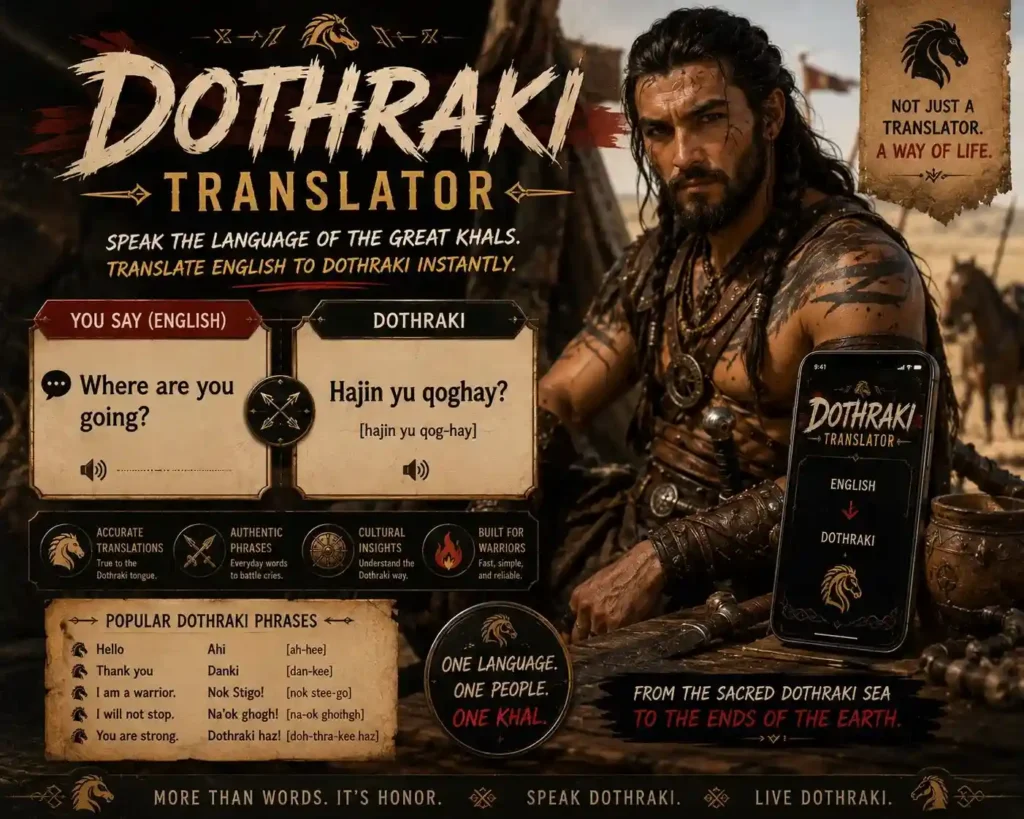
Fantasy Translator
Dothraki
Translates text into Dothraki, the language of Game of Thrones horse lords
What Is a Dothraki Translator?
A Dothraki Translator is a specialized language tool that converts modern English or any other language into Dothraki — the constructed language spoken by the Dothraki people in George R.R. Martin’s A Song of Ice and Fire series and HBO’s Game of Thrones. Unlike generic fantasy word generators, this translator draws on the authentic vocabulary, grammar, and cultural nuances of the language as developed by linguist David J. Peterson, ensuring output that feels genuine and immersive.
The History of the Dothraki Language
When HBO began production on Game of Thrones in 2010, George R.R. Martin had written only scattered Dothraki phrases in his books. HBO hired linguist David J. Peterson through the Language Creation Society to develop these fragments into a complete, functional language. Peterson delivered one of the most culturally cohesive constructed languages ever made.
Dothraki draws phonetic inspiration from Spanish, Arabic, Russian, and Estonian — giving it a harsh, guttural quality that perfectly reflects the warrior culture of its speakers. By the time Game of Thrones concluded, Peterson had developed Dothraki into a language with over 3,000 words, consistent grammatical rules, and a rich vocabulary shaped entirely by Dothraki culture.
Most famously, the Dothraki language has 14 words for horse but no word for thank you — a deliberate linguistic choice that says everything about who the Dothraki are as a people.
How the Translator Converts Text Into Dothraki
The translator analyzes your input text for meaning, tone, and
context, then reconstructs it using authentic Dothraki vocabulary
and grammar patterns. The output captures the direct, fierce, and
expressive quality of Dothraki speech — a language built for
warriors, riders, and the open steppe.
For example:
Plain English: “We ride at dawn.”
Dothraki: “Ajjin yer dothrae.”
Plain English: “You are my sun and stars.”
Dothraki: “Yer jalan atthirari anni.”
Plain English: “A Dothraki wedding without deaths is a dull affair.”
Dothraki: “Vosecchi anna Dothraki vaes mori, ajjalan vosma.”
Notice how Dothraki preserves directness and cultural weight —
every phrase carries the force and rhythm of the steppe.
What Makes Dothraki Unique as a Language
Dothraki stands apart from other constructed languages because of its extraordinary cultural specificity. Peterson built the vocabulary entirely around what the Dothraki people value and experience:
No word for thank you — gratitude is not a Dothraki concept.14 words for horse — the animal that defines their entire culture. The word for sea derives from the word for poison — the Dothraki fear the ocean.
Verbs of violence are among the most precisely conjugated in the language — reflecting a warrior culture’s attention to combat.
This cultural specificity is what separates Dothraki from generic fantasy languages. Every lexical choice tells you something about how the Dothraki see the world.
Want to learn more about Dothraki alongside the greatest constructed fantasy languages ever made? Read our guide to the 10 Best Fantasy Languages for Writers and Worldbuilders.
Dothraki vs High Valyrian — What Is the Difference?
Game of Thrones features two major constructed languages —
Dothraki and High Valyrian — and they are as different as the
cultures that speak them.
Dothraki is harsh, direct, and built for warriors. It is the
language of the steppe, of battle cries and blood oaths. Its
sounds are guttural and aggressive, reflecting a nomadic culture
that values strength above all else.
High Valyrian is elegant, musical, and ceremonial — the Latin
of Westeros. It is the ancient language of the Valyrian Freehold,
associated with power, magic, and aristocracy. Where Dothraki
sounds like thunder, High Valyrian sounds like poetry.
If Dothraki is the language of Khal Drogo, High Valyrian is the
language of Daenerys Targaryen addressing her dragons.
Also explore our Alien Translator for mysterious
extraterrestrial language, or our Yoda Translator for
the ancient wisdom of a Jedi Master.
Who Can Benefit from a Dothraki Translator?
The Dothraki Translator is perfect for Game of Thrones fans who
want to experience the language firsthand, writers and
worldbuilders drawing inspiration from Peterson’s cultural
linguistics, game developers creating immersive fantasy dialogue,
cosplayers preparing for conventions and themed events, and
educators exploring constructed languages and linguistic
worldbuilding in the classroom.
Explore more constructed and fantasy language translators in our full collection of Fantasy Translators, or discover the other great language of Game of Thrones with our High Valyrian Translator.
FAQs
RELATED POSTS
Free Sindarin Translator – Convert English to Sindarin Elvish
Speak the language of the High Elves. Convert English into Tolkien’s most elegant Elvish tongue — beloved by Middle-earth scholars, fans, and tattoo seekers.
Quenya Translator – Convert English to Elvish (Tolkien) Language
Speak the language of the High Elves. Convert English into Tolkien’s most elegant Elvish tongue — beloved by Middle-earth scholars, fans, and tattoo seekers.
Free Elvish Translator – Convert Any Text to Tolkien Elvish
Bring Middle-earth to life. Translate your name, vows, or story dialogue into authentic Tolkien-inspired Elvish — loved by cosplayers and fantasy writers.