LinguaTranslate vs Google Translate: Which One Actually Feels Better to Use?
Ever pasted a sentence into a translation tool and got back something that made zero sense — technically correct words, completely wrong vibe? Yeah, same here. Translation has come a long way, but not all tools have kept up with the way people actually communicate online. Some are built for textbooks. Others are built for the internet.
This comparison breaks down both platforms honestly — where each one works, where it fails, and which one actually fits what you are trying to do.
What Google Translate Is Really Good At
Google Translate became the default language app for most people because it solves a simple problem almost instantly. You type something, it translates it, done. That speed is still genuinely hard to beat.
For standard, everyday use it performs well. Translating a hotel check-in phrase, reading a foreign language news headline, or understanding a basic email from a client abroad — Google Translate handles all of that reliably. The camera translation feature is especially useful when you are traveling and need to read a menu or street sign in real time.
It also supports well over 100 languages, which is one of its biggest practical advantages. For a student doing homework, a business professional translating a document, or someone navigating a foreign city, it remains one of the most dependable free translation tools available.
For a sentence like “Where is the nearest train station?” it works perfectly. Clean input, clean output.
The problem starts when the input is anything but clean.
Why Google Translate Results Sometimes Feel Off
Most people have experienced this at least once. The translation is technically accurate but sounds like it was written by someone who has never had a casual conversation in their life.
It loses tone. It flattens emotion. It takes slang and turns it into something a textbook might say.
A gamer types: “Bro that boss fight was absolutely cooked.” Google Translate gives back a sentence that conveys the general idea but strips out all the personality. The result reads stiff, even though the original felt alive.
This is not really Google’s fault — it is just what happens when a translation tool is optimized for formal accuracy rather than cultural context. The meaning gets through. The feeling does not.
This gap becomes more obvious with internet language, where meaning is heavily tied to tone, community culture, and context that no dictionary can fully capture.
Where LinguaTranslator Feels Different
LinguaTranslator.app is not trying to be another standard language app. The platform takes a different angle entirely — instead of focusing only on direct translation between languages, it includes a wide range of style-based and creative translation tools that are built specifically for modern communication.
This shift changes the experience quite a bit. Someone who needs to translate a roleplay conversation, a gaming message, a fantasy story, or a social media caption has very different needs than someone translating a business contract. LinguaTranslator is built with that first group in mind.
The result is a platform that feels less like a utility and more like something you actually want to spend time in.
The Fantasy and Style Translator Problem Nobody Talks About
This is where traditional translation tools hit a wall they were never designed to climb.
Online communities speak in their own dialects. Discord servers, fantasy roleplay groups, anime fandoms, gaming chats — they all have their own way of expressing things. When someone wants to write a message in Elvish for a Lord of the Rings fan group, or translate dialogue into Quenya for a creative writing project, a standard language tool has absolutely nothing to offer.
The same goes for cultural mashups. Someone writing a bilingual caption that intentionally blends English and Spanish — what people call Spanglish — is not making a translation error. That mixing is the style. A tool that corrects it is missing the entire point.
Even something as playful as converting normal text into an alien language style for a sci-fi story or a TikTok joke has a genuine audience now. These are not niche edge cases anymore. They represent how a large chunk of the internet actually communicates.
Google Translate simply was not built for any of this. LinguaTranslator was.
Real Scenarios Where Each Tool Wins
Scenario 1: You are at an airport in Tokyo. You photograph a sign and need to know what it says right now. Google Translate wins this one easily. Camera translation, instant result, no setup required.
Scenario 2: You are writing dialogue for a fantasy RPG campaign. Your character is an ancient elven scholar. You want their speech to feel authentic and stylized. Google Translate gives you modern language with no character. A tool like the Quenya translator gives you something that actually sounds like it belongs in the world you are building.
Scenario 3: A friend sends you a meme in Korean and you want to understand why it is funny. Google Translate gives you the words. It probably will not give you the joke. Humor is cultural, timing-dependent, and often tied to internet references that a standard online translator cannot detect. This is exactly the gap that more context-aware translation tools are trying to close.
Scenario 4: You want to write a social media post that code-switches between English and Spanish intentionally. A standard language app treats this as an error to fix. The Spanglish translator treats it as the point.
Translation Is No Longer Just About Words
This is the thing that most comparisons of translation tools miss entirely.
Modern communication is loaded with sarcasm, subtext, emoji meaning, community-specific references, and tone that shifts the entire meaning of a sentence. “That’s insane” can mean genuine shock, impressed excitement, playful disbelief, or mild sarcasm depending entirely on context. Humans read this naturally. Most translation software still struggles with it.
The tools that are getting better are the ones treating translation as a cultural and contextual problem, not just a linguistic one. That requires understanding how communities speak, not just what words mean in isolation.
This is why creative translation tools are growing in popularity. They are not trying to replace formal translation — they are filling a gap that formal translation was never designed to address.
Interface and Day-to-Day Experience
Google Translate is clean, fast, and optimized. Opening it and getting a result takes seconds. For someone who just needs a quick answer in another language, there is almost no friction. It also works well across devices and integrates with Chrome, which makes it easy to translate entire websites without any extra steps.
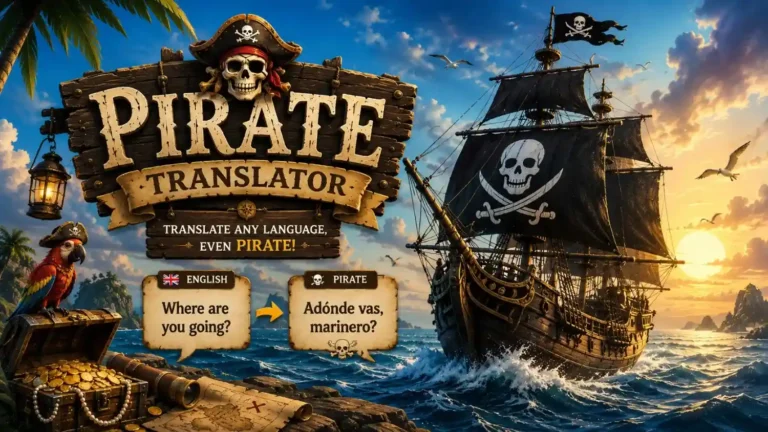
LinguaTranslator has a different energy. Because many of its tools are built around specific experiences rather than general translation, it rewards exploration. Someone looking for a Pirate translator or a Shakespearean English converter is going to find something genuinely useful and fun, not just a slightly different version of what Google already offers.
For casual users, content creators, and anyone who communicates in creative or community-driven spaces, that range of options makes LinguaTranslator feel more alive as a platform.
Can LinguaTranslator Replace Google Translate?
No — and it does not need to.
Google Translate is one of the most widely used language tools in the world for good reason. For travel, formal translation, multilingual professional communication, and quick everyday use, it remains extremely reliable. That is not going away.
But LinguaTranslator is doing something different. It is not competing on the same ground. It is building for the kind of communication that happens in Discord servers, creative writing communities, gaming groups, and social media — places where tone, style, and cultural context matter as much as literal meaning.
One is a utility. The other is a creative tool. They serve different needs, and honestly, most people will find value in having access to both.
Final Thoughts
Google Translate is still one of the fastest and most dependable free translation tools online. For standard translation needs, it does the job well and probably always will.
But language online is moving faster than traditional tools can follow. Slang evolves weekly. New internet dialects emerge constantly. Fantasy communities, gaming culture, and creative writing all demand something that dictionary-based translation simply cannot provide.
That is where LinguaTranslator.app fills a real gap. It is less focused on being technically precise and more focused on being actually useful for the way people communicate in 2025 — with personality, style, and cultural context built in.
If you have ever wanted to write in Elvish, experiment with Alien language, or find a tool that understands Spanglish as a legitimate style rather than a mistake — it is worth exploring.
The future of translation is not just accuracy. It is context, culture, and personality. And that future is already here.
RELATED POSTS
How to Speak Like a Pirate: The Complete Guide to Pirate Talk
How to Speak Like a Pirate — The Complete Guide Whether you’re gearing up for Talk Like a Pirate Day (September 19th), hosting a pirate-themed party, writing a swashbuckling story, or just want to entertain your friends, learning to speak like a pirate is one of the most fun linguistic adventures you can take. Pirate…
10 Best Fantasy Languages for Writers and Worldbuilders
10 Best Fantasy Languages for Writers and Worldbuilders If you’re a writer or worldbuilder, you already know that the details make the difference between a forgettable story and an unforgettable world. One of the most powerful — yet often overlooked — tools in a writer’s arsenal is language. A well-crafted fantasy language doesn’t just add…